Built-in refrigeration
Built-in refrigeration repair across St. Johns County
Built-in refrigeration is repaired around a cabinet opening, not replaced out of one. That single fact changes what is worth doing when it fails.
Independent Multi-brand St. Johns County, Florida
Monday – Friday 8:00am – 6:00pm $80 diagnostic
Access and clearances
Half of what a built-in repair costs is decided before the first screw comes out. Here is what governs access, and what it changes about the repair.
Published
Where this sits in a visit
Before anything is dismantled
How the appliance is fitted: the opening it sits in, the grille or toe-kick it breathes through, what has to come off to reach the back, and whether it rides on rails or has to be lifted.
What it settles. What the job will actually cost in time, and whether the fault is the installation rather than the appliance.
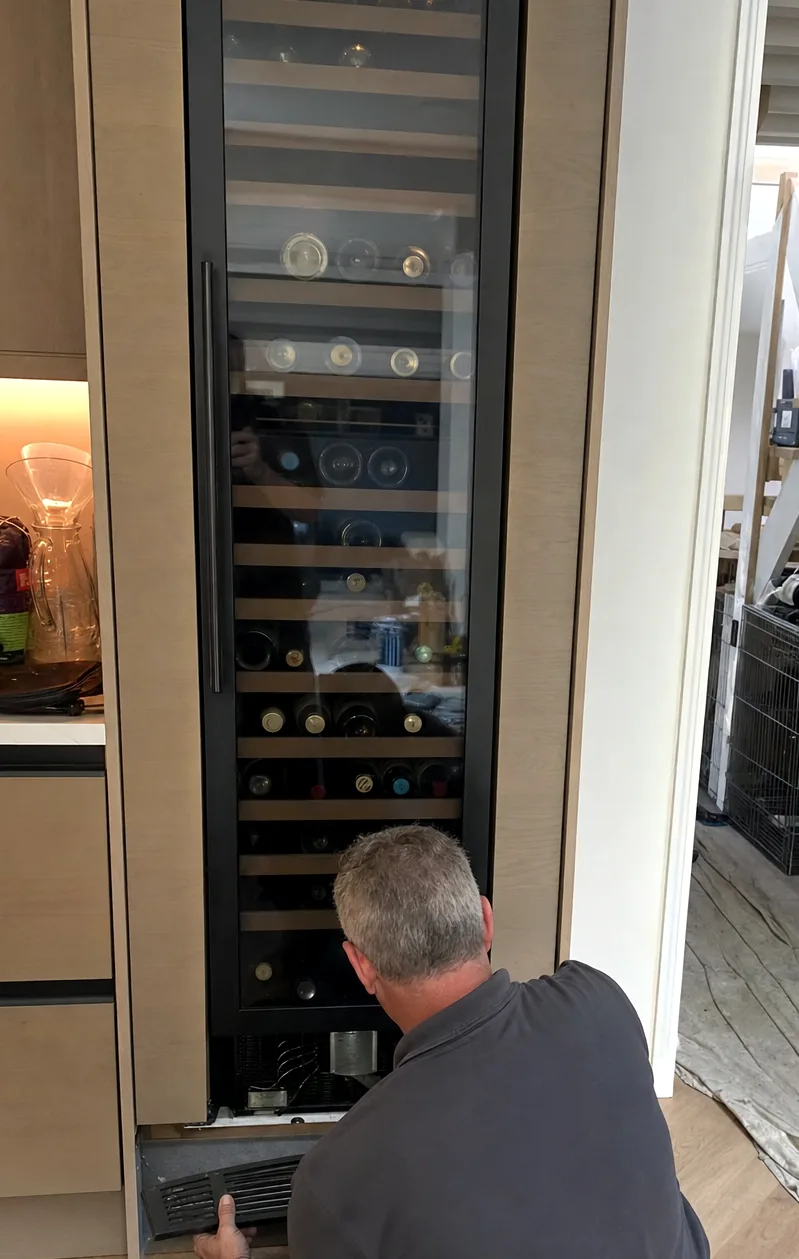
A freestanding appliance is pulled forward, worked on, and pushed back. A built-in is not an appliance in a nicer box: it is a machine sized to a framed opening, trimmed into the joinery around it, and ventilated through a grille that the cabinetmaker fitted. Everything about servicing one is governed by that fact, and most of what a repair costs in labor is decided before a single component is named.
Built-in refrigeration, wall ovens and dishwashers are each manufactured to a set of standard opening dimensions, and the cabinetry is built to receive them. When the appliance is being serviced rather than replaced, the questions are narrower but they still matter: how much clearance exists at the sides, whether the trim or filler panels have to come off first, whether the door can open far enough to lift out, and whether anything above the appliance has to be supported once it is moved.
The direction that causes the most trouble is depth. A shortfall in width can often be absorbed by trimming a stile; depth means moving a wall. That is worth knowing before anyone starts a conversation about replacement, because it is frequently the reason repairing a twenty-year-old built-in is the cheaper answer even when the repair looks expensive on its own.
Measure the narrowest point, not the average. Openings are rarely square, and a built-in that went in during construction may have gone in before a countertop, a floor build-up or a run of trim existed.
Built-in refrigeration and wall ovens are heavy, and the weight is not evenly distributed. A wall oven in a stack comes out onto a support at the height it already sits at, because lowering it to the floor and lifting it back is how doors get twisted and cabinetry gets marked. A column refrigerator carries most of its mass low and at the back, which is the least convenient place for it on a lift over a finished floor.
Floor protection is not fussiness. Engineered timber, tile with a soft grout line and luxury vinyl all mark under a point load, and an appliance that has to travel three feet is a point load on the move. Where an appliance rides on rails or rollers, those exist to be used — and where the rails have been fouled by a floor laid after the appliance went in, that gets dealt with before anything is pulled rather than during.
Every built-in has three connections worth worrying about, and the order to check them in is the order they cause trouble.
Power. Built-in ovens, cooktops and many built-in refrigerators are hardwired or on a dedicated circuit behind the cabinetry rather than plugged into a reachable socket. That has two consequences: there is no outlet to isolate at, so the circuit has to be identified and isolated at the panel; and there is no outlet to plug surge protection into, which is why panel-level protection is the only kind that covers this equipment.
Water. A plumbed connection may run to an ice maker, a dispenser, a steam oven or a coffee system. The shut-off is often behind the appliance that cannot be reached yet, which is a genuine chicken-and-egg problem and the reason we ask on the phone whether there is an accessible valve. Long, small-bore supply runs are common in older houses and they produce low pressure at the appliance — which presents exactly like a failing fill valve until it is measured.
Air. Built-in refrigeration rejects heat through a grille, and induction cooktops draw cooling air from beneath. Both paths are routinely closed off by work done after the appliance was installed: a cabinet run extended, a toe-kick blocked, a drawer insert fitted underneath, a plinth replaced with something solid. The appliance then runs hot, and the resulting fault reads as electrical.
Three things, and they are worth being blunt about.
It changes the labor. A component that is a twenty-minute job on a freestanding machine can be a two-hour job behind a panel and a countertop, and pretending otherwise on the phone helps nobody.
It changes the economics. Where an appliance cannot be replaced without replacing the joinery around it, the sensible spend on repairing it rises accordingly. That is not sentiment; it is why this class of equipment is designed to be serviced.
It changes who does what. Cabinetry alterations, countertop removal, new circuits and new supply lines are licensed trades and not us. We will tell you exactly what is needed and why, and then stop — and we would rather do that than quietly take a wall apart.
Whether the appliance is built-in, integrated or freestanding. Whether anything in the kitchen changed after it was installed — flooring, cabinetry, a disposal swap, a new countertop. Where the shut-off valve and the breaker are, if you know. And a clear route from the door to the kitchen, because the route matters as much as the opening when something has to come out.
The whole sequence
| Step | Stage | What happens | What it settles |
|---|---|---|---|
| 01 | Intake On the phone | Make, appliance, whether it is built-in or freestanding, the symptom in your words, how long it has been happening and what changed in the house around it. | Whether a visit is the right answer at all, and which parts are worth putting in the van before we set off. |
| 02 | Access Before anything is dismantled | How the appliance is fitted: the opening it sits in, the grille or toe-kick it breathes through, what has to come off to reach the back, and whether it rides on rails or has to be lifted. | What the job will actually cost in time, and whether the fault is the installation rather than the appliance. |
| 03 | Reproduce In your kitchen | The fault is made to happen under the conditions it fails in — a full cycle, a loaded pan, a door closed for an hour — rather than described from memory. | Intermittent against constant. A fault that will not reproduce is a different investigation from one that will. |
| 04 | Measure At the component | Electrical and thermal readings taken where the part lives: continuity and resistance, voltage under load rather than at rest, temperatures across the cavity or the coil, pressure and flow at the supply. | Which component is out of specification, as a number written down, rather than which one is easiest to sell. |
| 05 | Parts Against the serial number | The component identified against the model and serial, not the model alone, then checked for whether it is still current and what the lead time is. | Whether the repair can be finished at all. On older built-ins this is the question that decides everything after it. |
| 06 | Estimate Before any work | A written figure, itemised part by part with the labor against it, handed over before anything is fitted — including the case for not repairing it. | What you owe, and whether the appliance has a future worth spending it on. |
| 07 | Verify Before we leave | The appliance reassembled, levelled, resealed and run through a full cycle, with the readings from stage four taken again to confirm they moved. | That the original symptom is gone rather than merely quiet. The warranty starts from the date on that invoice. |
What repairs run
The visit is $80 flat and comes off the bill. What the repair costs depends on which part failed, so these are ranges, not quotes.
| Repair | Typical range |
|---|---|
| Compressor or sealed-system repair | $930–$2,460 |
| Evaporator or condenser fan motor | $250–$550 |
| Door gasket or seal replacement | $250–$640 |
| Diagnostic visit, credited to the repair | $80 |
Parts are itemised on the written estimate, and nothing is fitted before you have approved the figure.
Questions
Appliances this applies to
Built-in refrigeration
Built-in refrigeration is repaired around a cabinet opening, not replaced out of one. That single fact changes what is worth doing when it fails.
Dishwashers
Most dishwasher calls are one of four systems, and they are worth checking in a fixed order because three of them can imitate the fourth.
Wall & steam ovens
A conventional wall oven fails mechanically and predictably. A steam oven adds a whole second machine behind the cavity wall, with its own way of going wrong.
Terms
Written estimate before any work begins.