Warranty
Ninety days on the labor, a year on the part.
Every repair carries 90 days on labor and 365 days on the part, and both start on the invoice date. Genuine OEM parts only — we buy through authorized distribution and we do not fit pattern components into built-in appliances.
- Labor
- 90 days
- Parts
- 365 days
- Components
- Genuine OEM parts
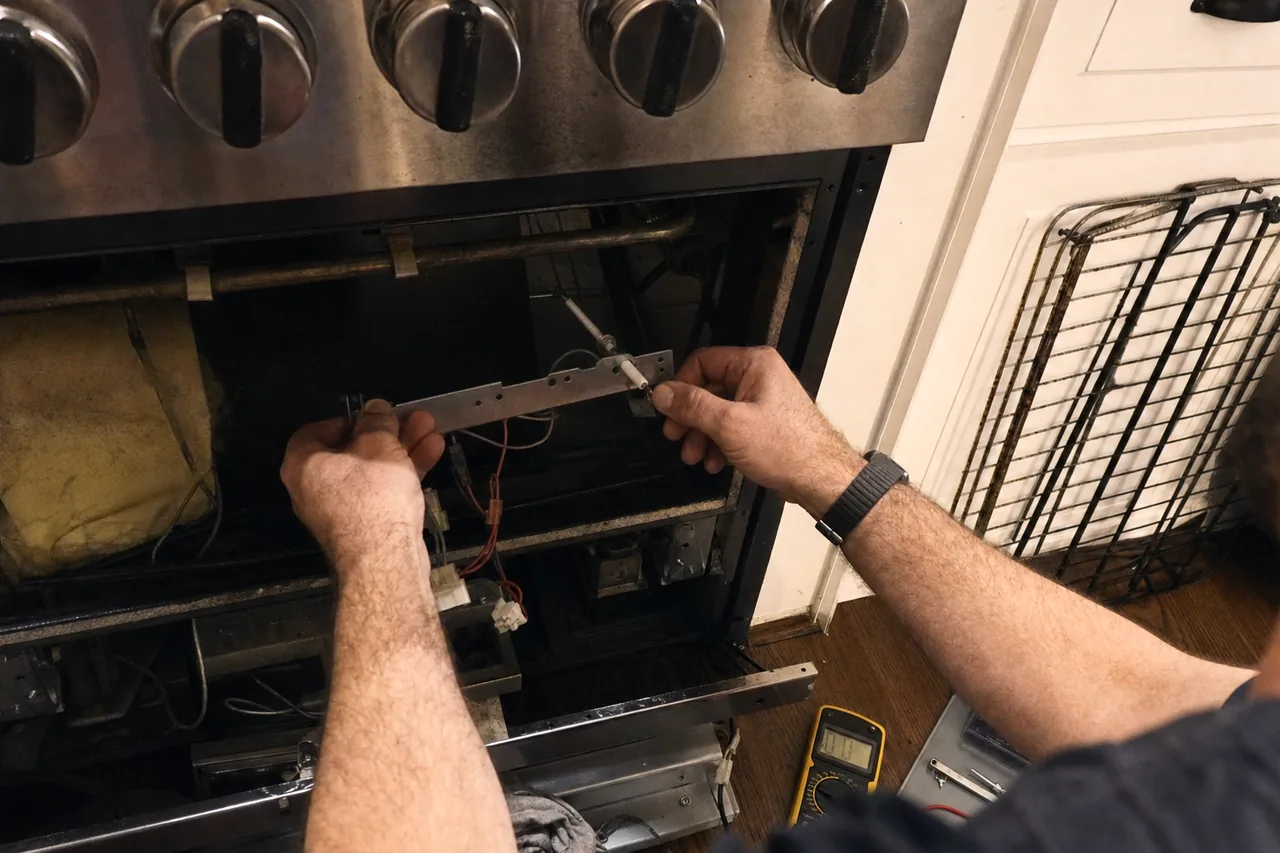
Covered
What the warranty actually promises
- The part we fitted, for 365 days from the date on the invoice, against failure in normal use.
- The labor to diagnose and replace that part again, for 90 days, at no charge and no second diagnostic fee.
- A return visit if the original symptom comes back within 90 days and the cause is the work we did.
- The fit itself — seals, alignment, levelling and reconnection on anything we removed to reach the part.
There is no registration, no card and no portal. The invoice is the warranty document; keep it or ask us and we will send it again.
To say the obvious thing plainly: this is the cover on a repair we carried out on a kitchen appliance. It is not a home warranty plan or an annual service contract, we do not sell one, and it has nothing to do with heating, air conditioning, roofing or anything else in the building.
Not covered
The exclusions, written down rather than implied
- A different fault on the same appliance. A new fault is a new visit, and we will say so plainly rather than quietly re-billing the first one.
- Parts you sourced yourself. We will fit them if they are correct, and the labor carries the 90 days, but the part carries whatever its seller offers.
- Deposit build-up that returns because a published maintenance interval was not kept. That is maintenance rather than a defect, and the interval is written on the invoice at the time.
- Surge damage after a later storm. A board that survives one summer and dies in the next has met a second event, not a defective repair.
- Damage from a subsequent installation change — a new supply line, a floor laid under the appliance, a cabinet reworked around it, a grille closed in.
- Appliances moved, altered or worked on by someone else after our visit.
The distinction that matters
A warranty covers the repair, not the cause of the repair
Every warranty in this trade draws the same line, and it is worth drawing it clearly rather than leaving it to be discovered. What we warrant is our work: the component we chose, the component we fitted, and the fit itself. What no warranty covers is the condition that made the part fail in the first place, if that condition is still there.
The clearest example is an installation fault. A control board fitted into a cavity that is still overheating because the cooling intake is blocked will fail again, and it will fail for the same reason it failed the first time. That is why access is stage two of every visit rather than an afterthought — if the environment is the cause, we say so, in writing, before anything is fitted. Where the correction is an electrician's or a cabinetmaker's job we will tell you that too, and then stop.
The second example is maintenance. Where an appliance has a published maintenance interval and the interval is what keeps the replacement alive, that interval goes on the invoice at the time of the repair rather than being produced afterwards as a reason to decline a claim. Keep it and the part lasts. Skip it and the same component fails the same way in the same place, which is a maintenance outcome rather than a defect.
None of this is a way of narrowing the promise. It is the reason the promise can be made at all: a company that warranted outcomes it does not control would have to price for them, and you would pay for that in every invoice whether or not it ever applied to you.
How a diagnostic visit works · What a visit costs · Questions we get asked
What repairs run
What does the warranted work itself cost?
The visit is $80 flat and comes off the bill. What the repair costs depends on which part failed, so these are ranges, not quotes.
| Repair | Typical range |
|---|---|
| Oven thermostat or temperature sensor | $190–$550 |
| Electronic control board | $400–$990 |
| Diagnostic visit, credited to the repair | $80 |
Parts are itemised on the written estimate, and nothing is fitted before you have approved the figure.
Questions
What do people ask about the warranty?
- How long is the work covered for?
- 90 days on labor and 365 days on parts, on the repair that was carried out. Genuine OEM parts throughout. If the fault that was fixed comes back inside those windows, the return visit for it is not charged again.
- What is not covered by the warranty?
- A different fault on the same appliance, damage from a later power event, and anything that was declined on the estimate and deliberately left alone. Those get quoted on their own terms. The line is drawn at the work on the invoice, not at the appliance as a whole.
- Does a second fault mean a second diagnostic fee?
- If it is genuinely a second fault, yes — it is a fresh diagnosis and the flat $80 applies, credited again against that repair. If it is the original fault returning inside the warranty window, no. Which of the two it is gets written down, not argued about.
- What if the appliance is still under the manufacturer’s warranty?
- Then say so when you call. That coverage sits between you and them, its terms vary by make, model and how the machine was registered, and we do not administer anybody else’s claim. Where it still applies, the honest advice is to use it rather than pay us.
Customer feedback
Three visits, including ones that needed a second trip
Rated 4.4 out of 5 across 100 customer reviews. Each is one visit, described by the person who paid for it.
The machine had begun stopping part way with a fault we could not read. He found the turbidity sensor fouled and the drain slow behind it, cleaned and replaced. It took two visits because the sensor had to be ordered.
Roderic N.2025-09-23
Our wine storage had crept up several degrees and the display was not admitting it. He measured the cabinet, found a condenser fan that had seized and a filter nobody had ever changed, and had it back in range that afternoon.
Alaric S.2026-03-02
Glasses were coming out etched and white. He tested our water hardness at the tap, set the softener in the machine to suit it and replaced a salt cap that was not sealing. He returned once to check the setting held.
Fitzwilliam B.2026-04-30
Making a claim
One phone call, and no forms
Call the number, say what it is doing and roughly when we were last out. If the symptom is the one we repaired and it is inside the window, the return visit carries no diagnostic fee. If it turns out to be a different fault, the ordinary $80 applies and we will tell you that before we come, not on the doorstep.