Skip to content

Independent Multi-brand St. Johns County, Florida

Monday – Friday 8:00am – 6:00pm $80 diagnostic

Repair or replace

Is it worth fixing? Here is the arithmetic.

Nobody asks this question about a toaster. They ask it about a machine that was built into the room, and that is what changes the answer: replacing a built-in means replacing what was built around it. Both halves of the sum are published on this site, so the comparison below is the same one the written estimate makes.

The dearest repair in this book
$2,460 at the top of the band
Half a comparable built-in
$5,800 where the rule draws its line
The appliance itself
$11,600–$16,800 before panels or fitting

Call (904) 395-4339

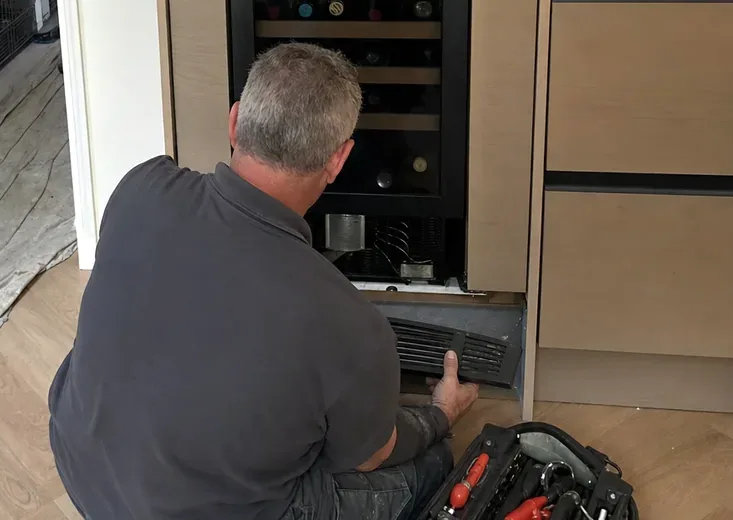
A technician kneeling at the foot of a built-in column with the lower grille held in one hand and the compressor bay open behind it, an unrolled tool kit on the floor beside him.
The arithmetic on this page starts here: what is behind that grille decides whether the number is a fan or a sealed system.

The rule people quote

What the 50% rule assumes, and where it stops working

The rule says stop once a repair reaches half the price of a new machine. It is a sound rule and it was written for a different appliance — a freestanding one, standing in a gap, that a delivery crew can swap in an hour with nothing else touched.

A built-in is not in a gap. It is in an aperture cut to it, usually with a panel matched to the run and sometimes with a countertop scribed over it. So the sum has three lines rather than one: the appliance at $11,600–$16,800, the panels and integrated cabinetry at $2,000–$5,000 on top of it, and the fitting after that. Half of the first line alone is $5,800, and the dearest repair anybody on this site can quote you tops out at $2,460.

Which is why the rule almost never triggers here, and why the honest version of it is narrower: not is the repair half the price of new, but does this machine have one fault or three, and does the part still exist. Those two questions decide nearly every replace recommendation we make.

The exceptions are real and worth naming. A freestanding range, a drop-in cooktop, an undercounter unit in a run that was never scribed — those genuinely do swap out, and on those the rule works exactly as written.

Both halves of the sum

What does the repair cost, and what does replacing it cost?

Repairs first, then what a replacement would be. The visit is $80 flat and comes off the repair bill, and no figure below is a quote — the firm number is written down after the diagnosis.

Typical repair bands, parts and labor together, before the diagnostic credit
Repair Typical range
Door gasket or seal replacement $250–$640
Evaporator or condenser fan motor $250–$550
Defrost heater, thermostat or sensor $240–$610
Ice maker, water valve or supply line $240–$650
Igniter, spark module or surface element $190–$520
Oven thermostat or temperature sensor $190–$550
Convection fan or motor $260–$670
Dishwasher pump or control $230–$660
Electronic control board $400–$990
Compressor or sealed-system repair $930–$2,460
Diagnostic visit, credited to the repair $80

And what does replacing it instead cost?

A comparable built-in refrigerator, appliance only — before delivery, installation, custom panels or cabinetry. Undercounter and wine units sit below this band; replacing a column pair is usually two purchases rather than one. Appliance pricing is national, unlike the labour above.

Replacement, for the repair-or-replace arithmetic
What you would be buying Range
Typical 36-42 inch built-in, the usual repair-or-replace comparison $11,600–$16,800
Custom panels and integrated cabinetry, on top of the appliance $2,000–$5,000
Replacement wine storage or an undercounter unit, appliance only $3,500–$5,500
A comparable built-in, appliance only, taken as a whole $8,600–$19,400

Parts are itemised on the written estimate, and nothing is fitted before you have approved the figure.

Three answers

Which of the three an estimate ends in

Repair, and it is not close

Airflow, ignition, heat control, drainage, seals, ice, and electronics.

This is most of the book and most of the work: a fan at $250–$550, a door gasket at $250–$640, an igniter or surface element at $190–$520, a dishwasher pump or control at $230–$660, an electronic control board at $400–$990. Every one of those sits a long way below the joinery bill that comes with pulling a built-in out, let alone the appliance behind it.

A judgement call, and it gets talked through

Sealed-system work, scarce parts, or a second fault of a different age.

A compressor or sealed-system repair is $930–$2,460 — still under the replacement band, but far enough up it that the rest of the machine has to be looked at honestly. What tips it is a second, unrelated fault, a serial-specific part on a long lead time, or corrosion that has reached the fasteners as well as the fins.

Replace, and we will say so

No part, several independent faults, or an appliance that needs no joinery.

Three cases end in a recommendation to replace: the component has gone out of supply and no sound alternative exists; the machine carries several independent faults of different ages, so fixing one buys the next; or it is freestanding, or a drop-in cooktop, and a replacement goes into the opening without a cabinetmaker. None of those is a repair worth selling you.

A comparable built-in refrigerator, appliance only — before delivery, installation, custom panels or cabinetry. Undercounter and wine units sit below this band; replacing a column pair is usually two purchases rather than one. Appliance pricing is national, unlike the labour above.

What moves the figure

Why two identical faults get two different quotes

  • Access A built-in that has to come out of a tight opening without damaging the joinery is time, and older St. Augustine kitchens give the worst of it. The part costs the same either way; the labor does not.
  • A serial-specific part Components are identified against the serial number, not the model alone. Where a running change means only one version fits, the lead time and the price are whatever that one part is.
  • A second fault Two faults of different ages on one appliance is the pattern that moves a job from repair to replace, and it is also the reason the whole machine is checked rather than only the complaint.
  • The fault being the installation A blocked intake, a drain hose that lost its high loop, a grille closed in by a toe kick. These are found on the diagnostic and frequently cost nothing to put right.
  • Catching it early An airflow fault caught while it is still a fan is one band. Left alone until it has cooked the control above it, it is two — and left longer than that, it reaches the sealed system.
  • The diagnostic coming off the bill The $80 is credited in full against the repair once you approve the work, so on any job that proceeds the diagnosis is effectively free.

90 days on labor, 365 days on parts, genuine OEM parts. The estimate separates parts from labor line by line, so which of these is doing the work to your figure is visible rather than implied.

Questions

What people ask before they decide

Is it worth fixing a built-in refrigerator, or should I replace it?
Usually worth fixing, because replacing a built-in means replacing what was built around it. Even the dearest repair in this book — a compressor or sealed system at $930–$2,460 — sits well under half of a comparable built-in before delivery, panels or joinery. The estimate carries both figures.
What is the 50% rule for appliance repair?
The rule people quote says stop once a repair reaches half the price of a new machine. It holds on a freestanding appliance that drops into a gap. On a built-in it rarely bites: half a comparable replacement is more than twice the top of this repair book.
Is it worth repairing a 20-year-old built-in refrigerator?
Often, yes. Equipment of that age is serviceable and most of what fails on it is mechanical rather than sealed. What settles it is parts — whether the component still exists and whether it is serial-specific — and that gets checked before the estimate is written, not after.
What is the most expensive part to replace on a refrigerator?
The compressor, and the sealed system around it: $930–$2,460, the top band on this site. An electronic control board is $400–$990 and a condenser or evaporator fan $250–$550. It is also the fault most often assumed from a warm compartment and least often confirmed.
How much does it cost to replace a compressor?
Sealed-system work runs $930–$2,460 here, parts and labor together, before the $80 diagnostic comes off. The spread is that wide because the job ranges from a straight component swap to recovering, repairing and recharging a system that has been standing open to the room.
Is it ever worth repairing a dishwasher?
An integrated one, usually. A pump or control is $230–$660, and pulling an integrated machine out of a run and fitting a replacement with its own door panel costs more than that before the appliance itself is paid for. A blocked drain path is frequently no part at all.
Is it worth repairing a cooktop or a range?
Nearly always, because cooking equipment is the cheap end of this book: an igniter, spark module or surface element is $190–$520, an oven sensor or thermostat $190–$550. A drop-in cooktop is also the one appliance that genuinely can be swapped without joinery, so it is the honest exception.
Is it worth calling somebody out at all?
Sometimes not, and you will be told so on the phone. Airflow, drains, seals, supply and loading habits are owner territory and cost nothing to check first. What the $80 buys is a measurement and a written figure, and it comes off the bill if the repair proceeds.
Customer feedback

Three jobs that ended in a decision

Rated 4.4 out of 5 across 100 customer reviews. Each is one visit, described by the person who paid for it.

  • Our induction top kept throwing a fault and shutting the zone down. He found the underside fan intake carpeted in dust and one power board connector browned. He cleaned the intake but the board took weeks to arrive.

    Lysander N.2026-05-08

  • The bin sensor had started reporting full when it was half empty. He cleaned the optics, found one emitter dull and replaced the pair, then ran the machine through a couple of cycles with us watching. One follow-up call needed.

    Ronan X.2026-03-10

  • The radiant element on our cooktop was cycling far more than it should. He measured it rather than replacing the board first, found the element drawing low, swapped it and rechecked. One return visit to finish the job.

    Aurelian V.2026-06-16

More of the 100, most recent first

Find out which one it is

$80 flat diagnostic fee, credited toward the repair.

Written estimate before any work begins. If the answer turns out to be that the machine has no future, you will be told that in the same visit, with the reason written down.

Scheduled appointments only. No after-hours or emergency service.

Call (904) 395-4339