Dishwashers
Dishwasher repair, and the four systems worth checking in order
Most dishwasher calls are one of four systems, and they are worth checking in a fixed order because three of them can imitate the fourth.
Independent Multi-brand St. Johns County, Florida
Monday – Friday 8:00am – 6:00pm $80 diagnostic
Miele error codes
The Miele F-codes owners see most on dishwashers and ovens, sorted into the ones you can safely clear and the ones that need a technician.
Published
Where this sits in a visit
On the phone
Make, appliance, whether it is built-in or freestanding, the symptom in your words, how long it has been happening and what changed in the house around it.
What it settles. Whether a visit is the right answer at all, and which parts are worth putting in the van before we set off.
A Miele error code is the letter F followed by a number: the appliance ran one of its own checks, found something out of range, and stopped the program. The number points to a system, not to a broken part. On a Miele dishwasher, F11 is a drain problem, F12 is a water supply problem and F14 usually means the pump dried out while the machine sat idle, and an owner can often clear all three in minutes. F70 is a different matter: the Waterproof system has tripped, and the right move is to shut off the water, unplug the machine and have it looked at.
Write the code down exactly, along with what the machine was doing when it appeared: filling, washing, draining, heating, or partway into a self-clean. It matters because Miele reuses numbers across its product lines. F11 on a dishwasher is a drain fault in the cabinet; F11 on a combi-steam oven means that oven’s drain hoses are blocked. Same characters, different appliance, different fix.
Then notice whether the code comes back after a power cycle. One that clears and never returns was often a passing condition, such as a faucet left half closed. One that returns on the next program is a pattern worth a closer look.
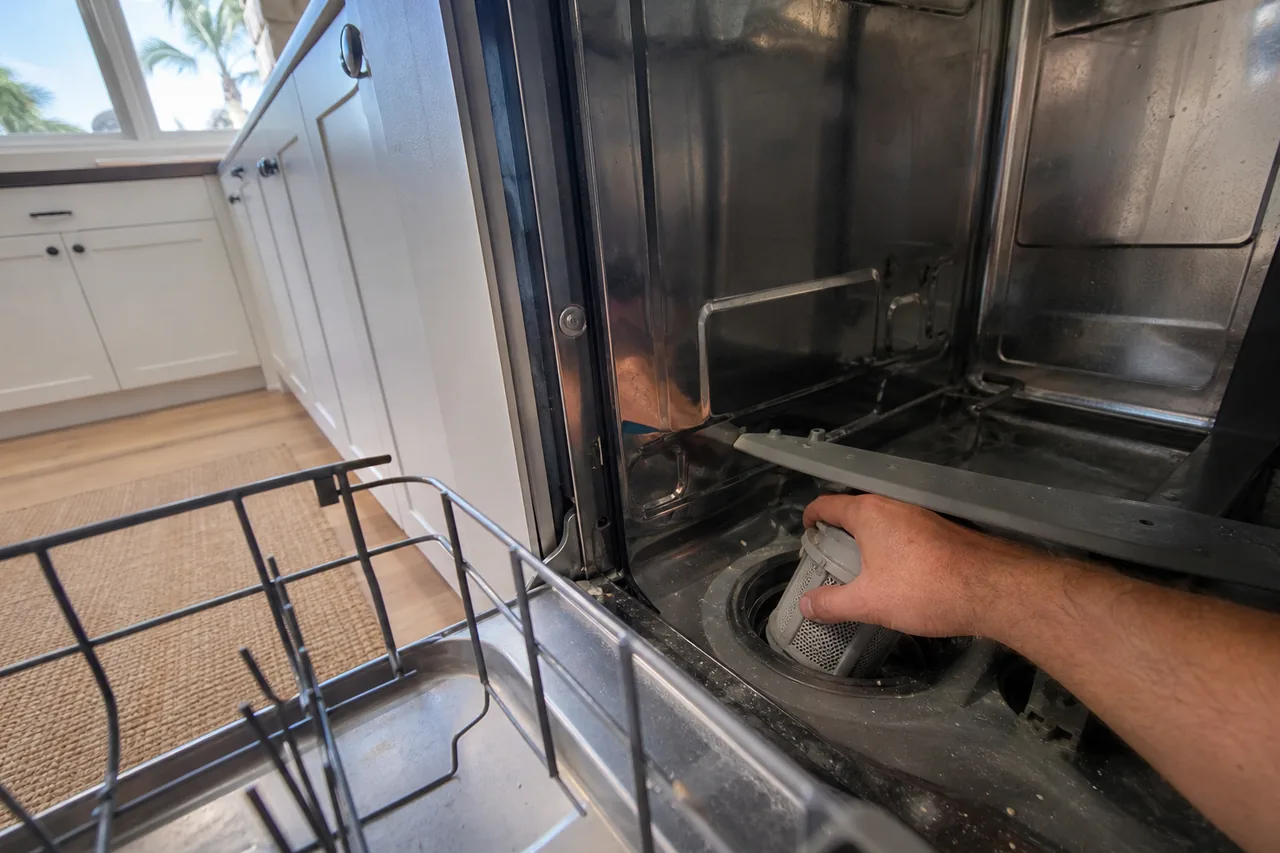
F11. If F11 appears with water still standing in the bottom of the tub, the dishwasher could not pump out. On models built from 2019 onward, unplug the machine first, lift out the filters and look into the drain pump: a shard of glass, a fruit pit or a curl of jar label is enough to jam it. Make sure the pump cover goes back flat and flush, because a cover that sits slightly raised can bring the same code straight back.
F12. This one means the water inlet is blocked or restricted. Confirm the supply valve under the sink is fully open, then unscrew the inlet hose and rinse the small filter inside its screw connection. Straighten any kink behind the machine, often left there after it was pulled out and pushed back. If all of that checks out, the household flow pressure may be below 7.25 psi (0.5 bar), and measuring that is a plumber’s job rather than an appliance repair.
F14. After weeks or months without use, the circulation pump can stick dry. The fix comes straight from Miele: pour 1 liter of hot water, no hotter than 165°F (75°C), mixed with 3 to 5 drops of rinse aid into the cabinet, wait 5 minutes, then start a program. A weekend place in Vilano Beach that stays closed for a season is exactly the kind of kitchen where this code turns up.
F600. On AutoDos models, F600 flags a fault at the dispensing outlet, so the program cancels and the drain pump runs. Clean the lower spray arm and the PowerDisk holder, let the AutoDos system dry completely, and then insert a full PowerDisk.
F70 tells you the Waterproof system has reacted, which in practice means the machine sensed water somewhere it should not be, usually in the base pan underneath. The program cancels and the drain pump runs by itself to protect your floor. Do not keep clearing it. Close the faucet, switch the dishwasher off and unplug it. Miele’s own instructions send you to service here, and rightly: the cause could be a hose, a fitting or a seal inside the cabinet, and the leak has to be found before another load. The dishwasher repair page explains the order in which those systems get checked.
F55 is a safety shut-off, not a failure. Miele ovens switch off after an unusually long stretch of operation: 6 hours in grill modes and 12 hours in every other mode. Turn the oven off and back on and it is ready to use immediately. If F55 shows up when the oven has not been running anywhere near that long, mention it when you book a visit.
F32 and F33 appear on certain Miele ovens with Self Clean. F32 means the door lock did not engage when the cleaning cycle should have started; F33 means it did not release afterward. Switch the oven off and on once. If either code returns, leave the door alone: a lock that misbehaves around a high-heat cleaning cycle is a service job, not something to force.
On combi-steam ovens the codes are mostly about water. F10 means the suction hose in the water container is not inserted correctly or is not standing upright, so reseat it. F11 on these ovens means the drain hoses are blocked. F20 is the oven asking to be descaled; running the descaling program as the manual describes clears it, and hard water brings it around sooner.
One message looks like a fault and is not: “Demo mode activated. Appliance does not heat up.” The oven is in a setting meant for store displays. Go to Settings, then Showroom, then Demo mode, select Off, then press and hold OK for at least 4 seconds and confirm. More on these ovens is on the wall oven and steam oven page.
Call once a code returns after you have done the owner checks one time, whenever F70 appears, and whenever F32 or F33 repeats. The same goes for any code the manual does not list, or any code that arrives with a burning smell, a tripped breaker or water on the floor.
Every visit begins with an $80 diagnostic. When a drain or circulation code turns out to be the dishwasher pump or its control, the typical range is $230–$660, with the firm figure given after diagnosis, once the actual part is known. St. Johns County Appliance is an independent repair service using genuine OEM parts, and the Miele page covers how the brand’s appliances tend to fail across the county.
The whole sequence
| Step | Stage | What happens | What it settles |
|---|---|---|---|
| 01 | Intake On the phone | Make, appliance, whether it is built-in or freestanding, the symptom in your words, how long it has been happening and what changed in the house around it. | Whether a visit is the right answer at all, and which parts are worth putting in the van before we set off. |
| 02 | Access Before anything is dismantled | How the appliance is fitted: the opening it sits in, the grille or toe-kick it breathes through, what has to come off to reach the back, and whether it rides on rails or has to be lifted. | What the job will actually cost in time, and whether the fault is the installation rather than the appliance. |
| 03 | Reproduce In your kitchen | The fault is made to happen under the conditions it fails in — a full cycle, a loaded pan, a door closed for an hour — rather than described from memory. | Intermittent against constant. A fault that will not reproduce is a different investigation from one that will. |
| 04 | Measure At the component | Electrical and thermal readings taken where the part lives: continuity and resistance, voltage under load rather than at rest, temperatures across the cavity or the coil, pressure and flow at the supply. | Which component is out of specification, as a number written down, rather than which one is easiest to sell. |
| 05 | Parts Against the serial number | The component identified against the model and serial, not the model alone, then checked for whether it is still current and what the lead time is. | Whether the repair can be finished at all. On older built-ins this is the question that decides everything after it. |
| 06 | Estimate Before any work | A written figure, itemised part by part with the labor against it, handed over before anything is fitted — including the case for not repairing it. | What you owe, and whether the appliance has a future worth spending it on. |
| 07 | Verify Before we leave | The appliance reassembled, levelled, resealed and run through a full cycle, with the readings from stage four taken again to confirm they moved. | That the original symptom is gone rather than merely quiet. The warranty starts from the date on that invoice. |
What repairs run
The visit is $80 flat and comes off the bill. What the repair costs depends on which part failed, so these are ranges, not quotes.
| Repair | Typical range |
|---|---|
| Door gasket or seal replacement | $250–$640 |
| Evaporator or condenser fan motor | $250–$550 |
| Defrost heater, thermostat or sensor | $240–$610 |
| Ice maker, water valve or supply line | $240–$650 |
| Diagnostic visit, credited to the repair | $80 |
Parts are itemised on the written estimate, and nothing is fitted before you have approved the figure.
Appliances this applies to
Dishwashers
Most dishwasher calls are one of four systems, and they are worth checking in a fixed order because three of them can imitate the fourth.
Wall & steam ovens
A conventional wall oven fails mechanically and predictably. A steam oven adds a whole second machine behind the cavity wall, with its own way of going wrong.
Terms
Written estimate before any work begins.