Built-in refrigeration
Built-in refrigeration repair across St. Johns County
Built-in refrigeration is repaired around a cabinet opening, not replaced out of one. That single fact changes what is worth doing when it fails.
Independent Multi-brand St. Johns County, Florida
Monday – Friday 8:00am – 6:00pm $80 diagnostic
Storms and control boards
Surge damage is cumulative and delayed, which is why the failure never lines up with the storm that caused it.
Published
Where this sits in a visit
At the component
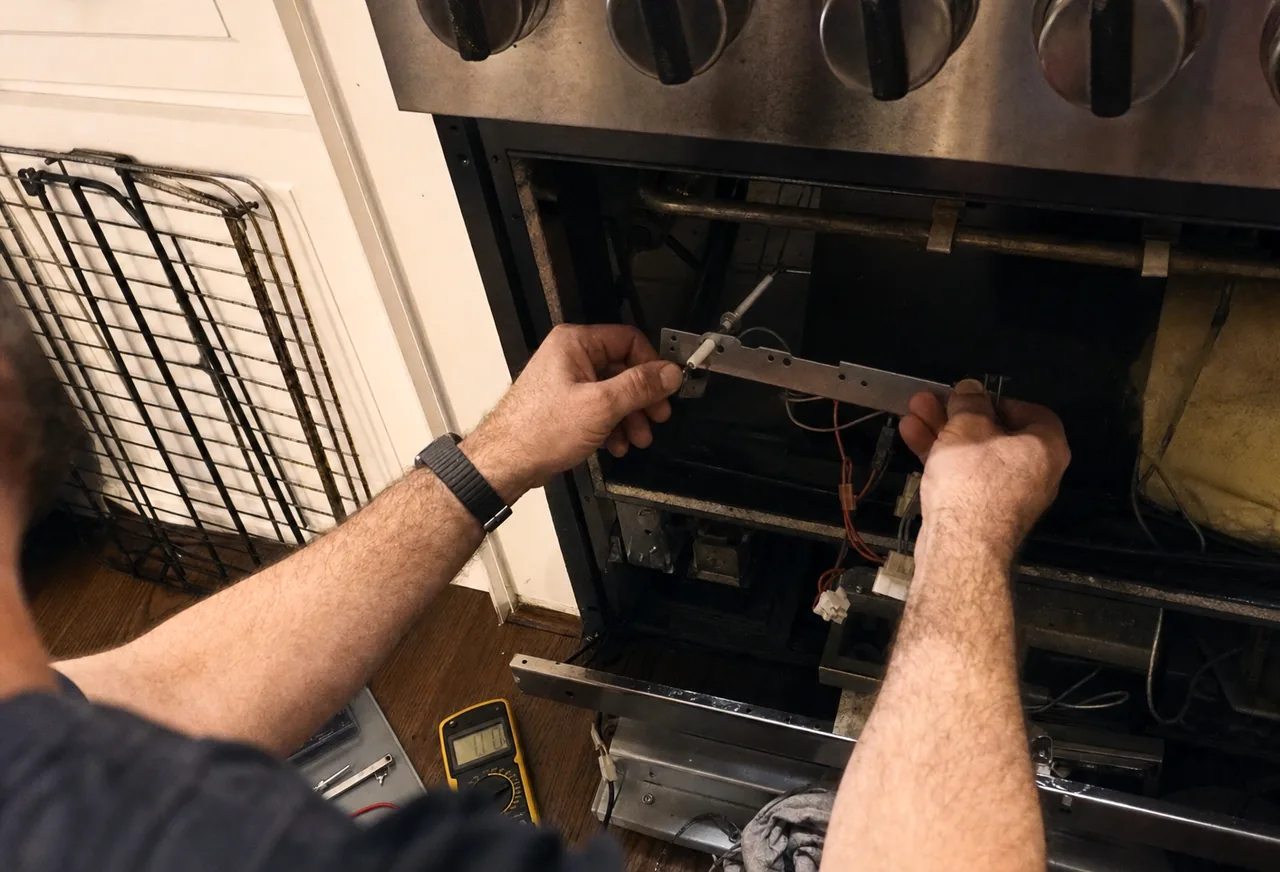
Electrical and thermal readings taken where the part lives: continuity and resistance, voltage under load rather than at rest, temperatures across the cavity or the coil, pressure and flow at the supply.
What it settles. Which component is out of specification, as a number written down, rather than which one is easiest to sell.
Northeast Florida runs roughly 68 thunderstorm days a year. That figure is worth sitting with: on more than one day in six, from roughly June to September, there is lightning somewhere over this county. It does not follow that appliances get struck. What follows is that they spend a season being exposed to a great many small voltage events.
We are going to be careful here, because surge damage attracts more nonsense than any other topic in this trade. We are not claiming to prove causation on any individual board. What we can describe honestly is a pattern we see across a service area of this size, year after year.
Control-board failures cluster in the autumn, not in the storm season.
The mechanism is not mysterious. A surge large enough to destroy a board outright destroys it immediately and everybody knows what happened — the power flickered, the oven died, the connection is obvious. Surges much smaller than that do not destroy anything. They degrade components: they stress capacitors, they punch through insulation microscopically, they weaken a semiconductor junction without opening it.
A degraded component still works. It works for weeks or months, with less margin than it had before, until an ordinary thermal cycle finishes it. By then the storm is a memory and the homeowner is entirely certain that nothing happened. Both things are true.
Three signatures come up often enough to mention.
A board that fails with no other cause on an appliance too young to fail. Four or five years old, no water ingress, no corrosion, no obvious thermal damage, and a dead board. That is the most common presentation.
Intermittent behaviour that becomes permanent. A display that flickered occasionally in August and is dark in November. A relay that clicked twice before engaging and now does not engage.
One board dead in a house where nothing else is. Appliances have wildly different surge exposure depending on whether they are hardwired, on a dedicated circuit, or sharing with the rest of the kitchen.
Protection at the panel, not at the outlet. A built-in oven, a cooktop, a built-in refrigerator and a dishwasher are frequently hardwired or on a dedicated circuit behind the cabinetry. There is no outlet to plug a strip into. A whole-house surge protective device at the service panel is the only thing that covers them, and it is an electrician’s job rather than ours.
A point-of-use protector where there genuinely is an outlet. Layered protection is real and works, but it protects only what is plugged into it.
A dedicated circuit. Older kitchens — particularly in the historic parts of St. Augustine 32084 — frequently lack dedicated 20-amp circuits for appliances that assume them. That produces nuisance tripping and it produces a dirtier electrical environment for the board.
We do not sell surge protection and we do not install it. We mention it because replacing the same board twice is a bad outcome for everyone.
It is not an explanation for every failure, and it is where a dishonest service company would stop looking. A dead board on a fifteen-year-old appliance is more likely age. A board that fails immediately after a water leak is a water problem. A board that fails on a coastal appliance with visible green corrosion on the headers is a salt problem, covered separately.
Diagnosis means ruling those out before reaching for the weather. We would rather find a five-dollar relay than sell a four-hundred-dollar board, and the $80 diagnostic exists precisely so that looking properly is paid for.
Check the other appliances before assuming only one was affected — a board that survived may be running on less margin than it was. If two boards in the same kitchen fail within a few months of each other, that is worth mentioning to an electrician rather than to us.
The whole sequence
| Step | Stage | What happens | What it settles |
|---|---|---|---|
| 01 | Intake On the phone | Make, appliance, whether it is built-in or freestanding, the symptom in your words, how long it has been happening and what changed in the house around it. | Whether a visit is the right answer at all, and which parts are worth putting in the van before we set off. |
| 02 | Access Before anything is dismantled | How the appliance is fitted: the opening it sits in, the grille or toe-kick it breathes through, what has to come off to reach the back, and whether it rides on rails or has to be lifted. | What the job will actually cost in time, and whether the fault is the installation rather than the appliance. |
| 03 | Reproduce In your kitchen | The fault is made to happen under the conditions it fails in — a full cycle, a loaded pan, a door closed for an hour — rather than described from memory. | Intermittent against constant. A fault that will not reproduce is a different investigation from one that will. |
| 04 | Measure At the component | Electrical and thermal readings taken where the part lives: continuity and resistance, voltage under load rather than at rest, temperatures across the cavity or the coil, pressure and flow at the supply. | Which component is out of specification, as a number written down, rather than which one is easiest to sell. |
| 05 | Parts Against the serial number | The component identified against the model and serial, not the model alone, then checked for whether it is still current and what the lead time is. | Whether the repair can be finished at all. On older built-ins this is the question that decides everything after it. |
| 06 | Estimate Before any work | A written figure, itemised part by part with the labor against it, handed over before anything is fitted — including the case for not repairing it. | What you owe, and whether the appliance has a future worth spending it on. |
| 07 | Verify Before we leave | The appliance reassembled, levelled, resealed and run through a full cycle, with the readings from stage four taken again to confirm they moved. | That the original symptom is gone rather than merely quiet. The warranty starts from the date on that invoice. |
What repairs run
The visit is $80 flat and comes off the bill. What the repair costs depends on which part failed, so these are ranges, not quotes.
| Repair | Typical range |
|---|---|
| Electronic control board | $400–$990 |
| Oven thermostat or temperature sensor | $190–$550 |
| Diagnostic visit, credited to the repair | $80 |
Parts are itemised on the written estimate, and nothing is fitted before you have approved the figure.
Questions
Appliances this applies to
Built-in refrigeration
Built-in refrigeration is repaired around a cabinet opening, not replaced out of one. That single fact changes what is worth doing when it fails.
Ranges & cooktops
Cooking appliances never meet the water supply, so their failures come from ignition, heat control, cooling airflow and the coastal and storm environment.
Wall & steam ovens
A conventional wall oven fails mechanically and predictably. A steam oven adds a whole second machine behind the cavity wall, with its own way of going wrong.
Terms
Written estimate before any work begins.