Built-in refrigeration
Built-in refrigeration repair across St. Johns County
Built-in refrigeration is repaired around a cabinet opening, not replaced out of one. That single fact changes what is worth doing when it fails.
Independent Multi-brand St. Johns County, Florida
Monday – Friday 8:00am – 6:00pm $80 diagnostic
The diagnostic sequence
Seven stages, in a fixed order, each one ruling something out before the next one costs money. This is the sequence the whole site is organised around.
Published
Where this sits in a visit
At the component
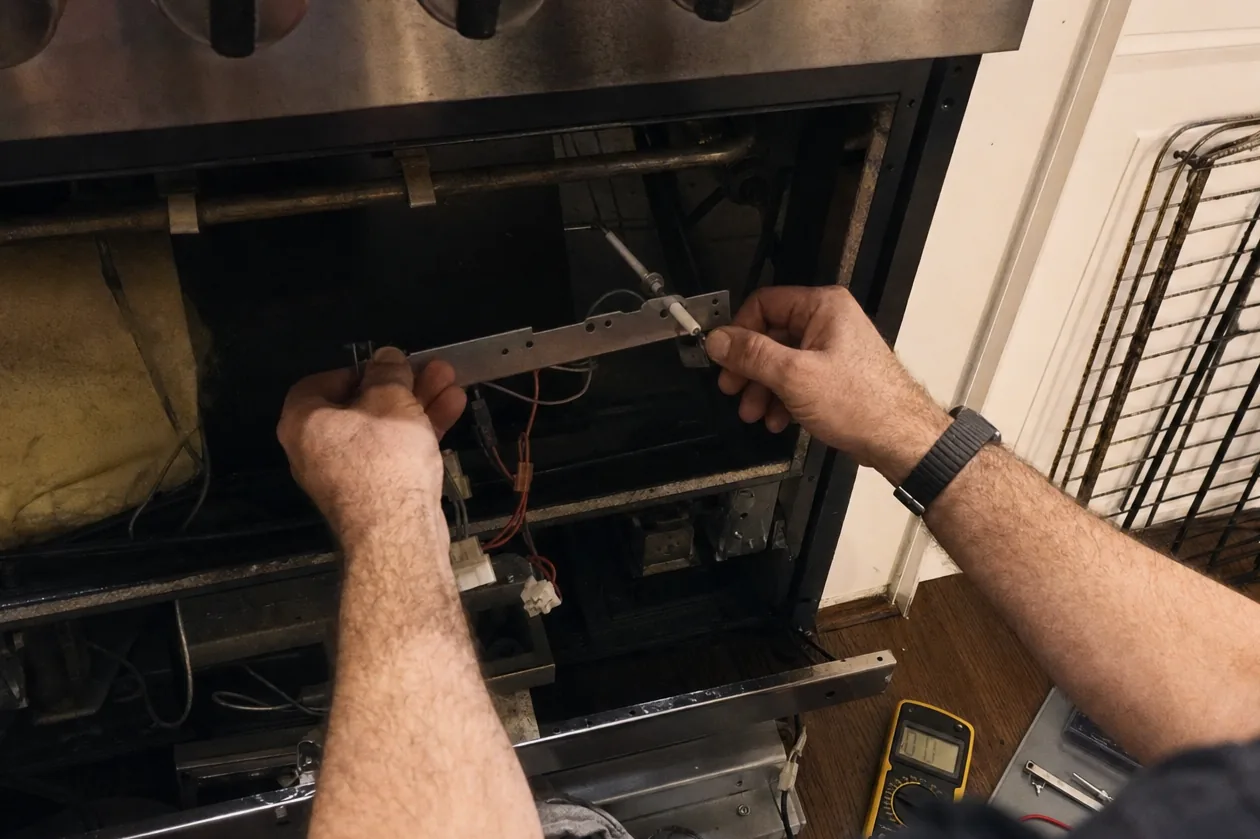
Electrical and thermal readings taken where the part lives: continuity and resistance, voltage under load rather than at rest, temperatures across the cavity or the coil, pressure and flow at the supply.
What it settles. Which component is out of specification, as a number written down, rather than which one is easiest to sell.
A repair visit is not one activity. It is seven, in a fixed order, and the order does more work than any individual step in it. Every stage exists to rule something out cheaply before the next stage rules something out expensively, and the single most common way a repair goes wrong is that somebody skipped straight to stage five and fitted a part.
Take the most frequent complaint we get: an induction element that works from cold and cuts out after fifteen minutes under a heavy pan. If you start at parts, that symptom points at the power board, the board gets ordered, and the board gets fitted into a cavity that is still overheating. The appliance fails again, the homeowner has paid for a board, and nothing has been learned.
Start at access instead and the drawer insert blocking the cooling intake is visible in ninety seconds. The board was never faulty. The order of operations is the difference between those two visits, and it costs nothing to follow.
The same logic runs the other way too. Reproducing a fault before measuring anything sounds like a delay; it is the step that separates intermittent behaviour from constant behaviour, and those two categories have almost no diagnostic overlap. A connection that has corroded misbehaves. A component that has failed stays failed. If the fault will not reproduce, chasing readings is guessing with a meter in your hand.
This is the phone call, and it is genuinely part of the diagnosis rather than a booking formality. What make it is. Whether the appliance is built-in, integrated or freestanding, because that changes the access problem entirely. What it is doing, in your words. How long it has been doing it, and whether it arrived gradually or overnight — gradual is nearly always wear or deposit, overnight is nearly always electrical or mechanical.
The most useful thing a homeowner can offer here is a measurement rather than an adjective. “The preheat used to take twelve minutes and now takes twenty” is worth more than “the oven is not heating properly”, because the second sentence covers a drifted sensor, a failed element, a weak door hinge and a miscalibrated control, and the first one narrows it.
Intake also decides what rides in the van. A visit that arrives with the likely part on board finishes in one trip; a visit that does not costs everyone a second appointment.
How is the appliance actually installed? A built-in refrigerator is trimmed into joinery and breathes through a grille that is part of the cabinetry. A wall oven sits in a stack and is heavy enough that it comes out onto a support, not onto the floor. A dishwasher is often held by the countertop above it, and in a stone-topped kitchen that fixing is not something to discover halfway through.
Then the services: is the circuit dedicated, is it live, is the supply valve open, is the drain clear downstream of the appliance. A surprising share of “the appliance is broken” calls end here, and end without a part.
The fault has to happen while we are standing in front of it, under the conditions it fails in — a full cycle rather than a two-minute test, a loaded pan rather than an empty one, a door closed for an hour rather than opened every five minutes. Faults that only appear under load are the ones most often misdiagnosed, because a bench test of the same component passes.
Where a fault genuinely will not reproduce, we say so and we say what we would watch for, rather than fitting something speculative and calling it a repair.
This is where the visit stops being observation and becomes evidence. Continuity and resistance on elements, sensors and windings. Voltage under load rather than at rest, because a connection can read perfectly with nothing flowing through it and collapse the moment it is asked to carry current. Temperatures across a cavity or a coil. Pressure and flow at the supply, which is worth its own sentence: low pressure at an ice maker presents exactly like a failing fill valve until somebody measures it.
Tap water in this county is hard — every ZIP JEA publishes a figure for in St. Johns County is above 300 parts per million as calcium carbonate — so mineral deposit on a heating element, a valve seat or a spray jet is one of the ordinary things we check at this stage. It is a reading, not a diagnosis: a deposit that is present may or may not be what you called us about.
The part is identified against the model and the serial number, because manufacturers make running changes mid-production and the same model can take two different components depending on when it left the factory. Then two questions: does it still exist, and how long does it take to arrive. On an older built-in those answers decide the whole conversation, which is why we ask them before quoting rather than after.
The estimate is written, itemised part by part with the labor against it, and it is handed over before anything is fitted. It includes the case against the repair where there is one.
Verification is the stage people forget exists. The appliance is reassembled, levelled, resealed and run through a full cycle, and the readings from stage four are taken again to confirm they moved. A repair that has not been measured twice is a repair that has been hoped for.
One flat diagnostic fee covers all of it, and it is credited against the repair if you go ahead. The fee is flat on purpose: looking properly takes longer in some kitchens than others, and the price of looking should not punish the houses where the installation is part of the problem.
The whole sequence
| Step | Stage | What happens | What it settles |
|---|---|---|---|
| 01 | Intake On the phone | Make, appliance, whether it is built-in or freestanding, the symptom in your words, how long it has been happening and what changed in the house around it. | Whether a visit is the right answer at all, and which parts are worth putting in the van before we set off. |
| 02 | Access Before anything is dismantled | How the appliance is fitted: the opening it sits in, the grille or toe-kick it breathes through, what has to come off to reach the back, and whether it rides on rails or has to be lifted. | What the job will actually cost in time, and whether the fault is the installation rather than the appliance. |
| 03 | Reproduce In your kitchen | The fault is made to happen under the conditions it fails in — a full cycle, a loaded pan, a door closed for an hour — rather than described from memory. | Intermittent against constant. A fault that will not reproduce is a different investigation from one that will. |
| 04 | Measure At the component | Electrical and thermal readings taken where the part lives: continuity and resistance, voltage under load rather than at rest, temperatures across the cavity or the coil, pressure and flow at the supply. | Which component is out of specification, as a number written down, rather than which one is easiest to sell. |
| 05 | Parts Against the serial number | The component identified against the model and serial, not the model alone, then checked for whether it is still current and what the lead time is. | Whether the repair can be finished at all. On older built-ins this is the question that decides everything after it. |
| 06 | Estimate Before any work | A written figure, itemised part by part with the labor against it, handed over before anything is fitted — including the case for not repairing it. | What you owe, and whether the appliance has a future worth spending it on. |
| 07 | Verify Before we leave | The appliance reassembled, levelled, resealed and run through a full cycle, with the readings from stage four taken again to confirm they moved. | That the original symptom is gone rather than merely quiet. The warranty starts from the date on that invoice. |
What repairs run
The visit is $80 flat and comes off the bill. What the repair costs depends on which part failed, so these are ranges, not quotes.
| Repair | Typical range |
|---|---|
| Oven thermostat or temperature sensor | $190–$550 |
| Electronic control board | $400–$990 |
| Diagnostic visit, credited to the repair | $80 |
Parts are itemised on the written estimate, and nothing is fitted before you have approved the figure.
Questions
Appliances this applies to
Built-in refrigeration
Built-in refrigeration is repaired around a cabinet opening, not replaced out of one. That single fact changes what is worth doing when it fails.
Ice makers
An ice maker is a small refrigeration circuit with a plumbing problem attached, and it almost always degrades quietly rather than failing outright.
Dishwashers
Most dishwasher calls are one of four systems, and they are worth checking in a fixed order because three of them can imitate the fourth.
Ranges & cooktops
Cooking appliances never meet the water supply, so their failures come from ignition, heat control, cooling airflow and the coastal and storm environment.
Wall & steam ovens
A conventional wall oven fails mechanically and predictably. A steam oven adds a whole second machine behind the cavity wall, with its own way of going wrong.
Terms
Written estimate before any work begins.