Built-in refrigeration
Built-in refrigeration repair across St. Johns County
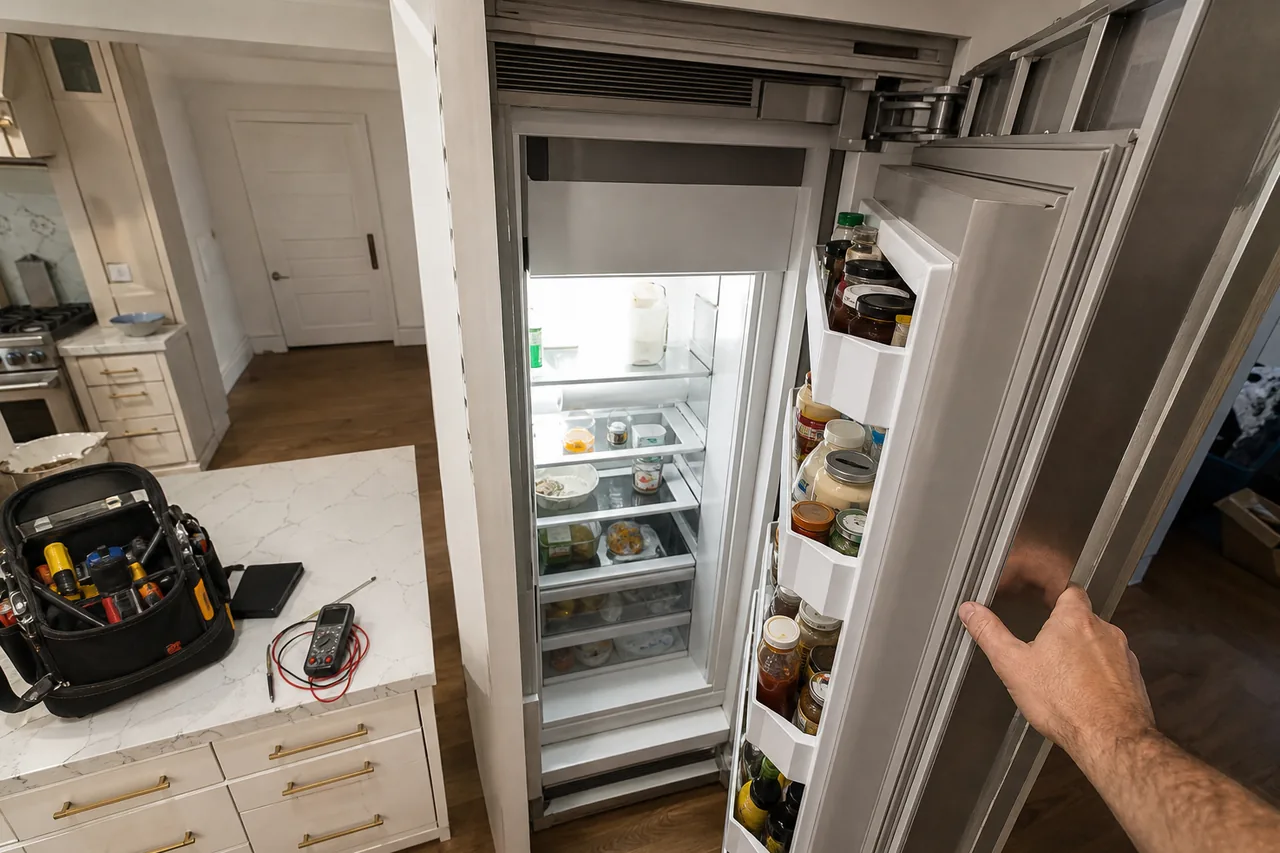
Built-in refrigeration is repaired around a cabinet opening, not replaced out of one. That single fact changes what is worth doing when it fails.
Independent Multi-brand St. Johns County, Florida
Monday – Friday 8:00am – 6:00pm $80 diagnostic
Bosch vs Miele
A fair look at Bosch and Miele dishwashers, ranges, wall ovens and refrigerators: how each is built, where each tends to fail and what service involves.
Published
Where this sits in a visit
On the phone
Make, appliance, whether it is built-in or freestanding, the symptom in your words, how long it has been happening and what changed in the house around it.
What it settles. Whether a visit is the right answer at all, and which parts are worth putting in the van before we set off.
Bosch is not better than Miele across the board, and the reverse is not true either. Miele asks a higher price, makes more of its own components and designs its machines for a long working life; Bosch delivers most of the same day-to-day performance for less money, and its parts are usually easier to find in this country. On dishwashers the two are nearly level: Bosch rates its Benchmark SHP9PCM5N at 38 dBA, and Miele’s quietest US models, the G 7986 SCVi AutoDos K2O and the G 7766 SCVi AutoDos, are listed at 39 dB. Nobody hears one decibel across a kitchen, so the choice comes down to features, budget and the kind of installation you want.
Miele is a family-owned German company that keeps much of its engineering and component production in its own plants. Its whole range sits at the upper end of the market, so there is no entry-level Miele to set against a basic Bosch.
Bosch belongs to a large appliance group that also owns Thermador, and it sells in clear tiers, with the 500 Series and 800 Series below the Benchmark line at the top. A Bosch from the top of its range and a Miele from the bottom of its range often sit closer in features than the badges suggest.
Miele’s US dishwasher suffixes spell out the installation. SCVi means fully integrated, with the controls hidden on the top edge of the door, as on the G 7986 SCVi AutoDos K2O. SCi means semi-integrated with a visible control strip, as on the G 7936 SCi AutoDos. SCU marks a built-under model with its own front, such as the G 7216 SCU. AutoDos in a name means the machine measures out detergent by itself from a cartridge.
Bosch’s answer at the top is CrystalDry on the Benchmark SHP9PCM5N, which uses a mineral that soaks up moisture and gives off heat, so plastic containers come out drier. Noise climbs as price drops: Miele lists the G 7186 SCVi AutoDos at 42 dB and the built-under G 5008 SCU Active at 44 dB. Both brands fit the standard 24-inch opening, so trading one for the other in an existing St. Johns County kitchen is fairly simple, although a panel-ready model needs its custom front refitted.
Bosch’s 800 Series HGI8056UC is a 30-inch gas slide-in whose center burner is rated at 18,000 BTU on natural gas and 15,000 on propane, with an 18,000 / 12,500 BTU bake and broil pair and a 4.8 cu. ft. oven. It drops into an ordinary cabinet run.
Miele’s ranges are professional-style machines, and the end of the model name tells you the fuel: DF for dual fuel, as on the HR 1924-3 G DF; AG for all-gas, as on the HR 1124-3 G AG; and I for induction, as on the HR 1622-3 I. Propane versions are separate models, such as the HR 1934-3 LP DF, so a house on bottled gas should order the right one from the start.
On wall ovens, Miele offers the 30-inch H 7880 BP, the H 7780 BP2 double, the handleless H 7880 BPX and compact speed ovens like the H 7270 BM. Bosch’s 500 Series built-in ovens, such as the HBL5451UC, fill the same openings, generally with fewer automatic programs. More programs bring convenience, and also more electronics to diagnose.
This is where the brands differ most. Miele’s MasterCool line is made for cabinetry: K for refrigerator columns (K 2802 Vi), F for freezer columns (F 2812 Vi), KF for bottom-mount units (KF 2902 Vi), KWT for wine storage (KWT 2612 Vi) and KFMC for furniture-front bottom-mounts (KFMC 3846 R). Columns can be paired behind matching panels. Bosch’s refrigerators are mostly freestanding or counter-depth French-door models, which cost far less and roll out of their space for service.
Sealed-system repair has changed on both. Many current refrigerators run on hydrocarbon refrigerants such as R-600a or R-290, and since EPA adopted the 2017 UL 60335-2-24 standard in 2018, each circuit may hold up to 150 grams (5.29 ounces), up from the old 57-gram cap. Those gases are flammable, so leak repair and recharging call for proper equipment.
Neither brand is fragile, and both wear in predictable places. On Bosch dishwashers, the usual calls involve a clogged filter or drain pump and the leak sensor in the base pan, which halts the program when it finds water underneath. On Miele dishwashers, drain and inlet faults appear as F-codes, which our Miele code guide walks through. On either badge, a dishwasher pump or control repair typically lands in the $230–$660 range, with the firm figure given after the $80 diagnostic.
Gas ranges from both makers eventually need an igniter, and slow lighting of the bake burner is the usual sign. Built-in refrigerators most often need new door seals or quieter fans, and a weak seal matters more in humid coastal air because frost builds faster.
Before booking a repair, find the rating plate. On a Bosch dishwasher such as the SHP78CM5N it sits on the inside of the door and lists the E-Nr. (product number), the FD (production number) and the Z-Nr. (consecutive number). On an electric slide-in like the HEI8056U, open the storage drawer and look at the back of the drawer front. On a 500 Series wall oven like the HBL5451UC, check the left side of the door trim on bottom-hinge ovens, using the lower cavity on doubles, or the side opposite the hinge on side-hinge singles. Miele prints its model and serial details on a data plate too, and a phone photo of either plate helps the right part arrive first time.
Bosch sells in volume, so common parts are usually stocked in the US. Miele parts more often ship through the maker’s own channel, and an uncommon one can take longer. We repair both brands; see our Bosch and Miele pages.
Pick Bosch for strong cleaning and very low noise for less money, or a range that slides into a standard cabinet run. Pick Miele for a fully integrated look, automatic detergent dosing, a pro-style range with a choice of fuel, or refrigeration columns that vanish behind panels. Either way, a level install and open airflow will matter as much as the badge.
The whole sequence
| Step | Stage | What happens | What it settles |
|---|---|---|---|
| 01 | Intake On the phone | Make, appliance, whether it is built-in or freestanding, the symptom in your words, how long it has been happening and what changed in the house around it. | Whether a visit is the right answer at all, and which parts are worth putting in the van before we set off. |
| 02 | Access Before anything is dismantled | How the appliance is fitted: the opening it sits in, the grille or toe-kick it breathes through, what has to come off to reach the back, and whether it rides on rails or has to be lifted. | What the job will actually cost in time, and whether the fault is the installation rather than the appliance. |
| 03 | Reproduce In your kitchen | The fault is made to happen under the conditions it fails in — a full cycle, a loaded pan, a door closed for an hour — rather than described from memory. | Intermittent against constant. A fault that will not reproduce is a different investigation from one that will. |
| 04 | Measure At the component | Electrical and thermal readings taken where the part lives: continuity and resistance, voltage under load rather than at rest, temperatures across the cavity or the coil, pressure and flow at the supply. | Which component is out of specification, as a number written down, rather than which one is easiest to sell. |
| 05 | Parts Against the serial number | The component identified against the model and serial, not the model alone, then checked for whether it is still current and what the lead time is. | Whether the repair can be finished at all. On older built-ins this is the question that decides everything after it. |
| 06 | Estimate Before any work | A written figure, itemised part by part with the labor against it, handed over before anything is fitted — including the case for not repairing it. | What you owe, and whether the appliance has a future worth spending it on. |
| 07 | Verify Before we leave | The appliance reassembled, levelled, resealed and run through a full cycle, with the readings from stage four taken again to confirm they moved. | That the original symptom is gone rather than merely quiet. The warranty starts from the date on that invoice. |
What repairs run
The visit is $80 flat and comes off the bill. What the repair costs depends on which part failed, so these are ranges, not quotes.
| Repair | Typical range |
|---|---|
| Door gasket or seal replacement | $250–$640 |
| Evaporator or condenser fan motor | $250–$550 |
| Defrost heater, thermostat or sensor | $240–$610 |
| Ice maker, water valve or supply line | $240–$650 |
| Diagnostic visit, credited to the repair | $80 |
Parts are itemised on the written estimate, and nothing is fitted before you have approved the figure.
Appliances this applies to
Built-in refrigeration
Built-in refrigeration is repaired around a cabinet opening, not replaced out of one. That single fact changes what is worth doing when it fails.
Dishwashers
Most dishwasher calls are one of four systems, and they are worth checking in a fixed order because three of them can imitate the fourth.
Ranges & cooktops
Cooking appliances never meet the water supply, so their failures come from ignition, heat control, cooling airflow and the coastal and storm environment.
Wall & steam ovens
A conventional wall oven fails mechanically and predictably. A steam oven adds a whole second machine behind the cavity wall, with its own way of going wrong.
Terms
Written estimate before any work begins.